Out in the Open: Rendcomb's Pupil Art Trail Charts New Ground Across the Estate
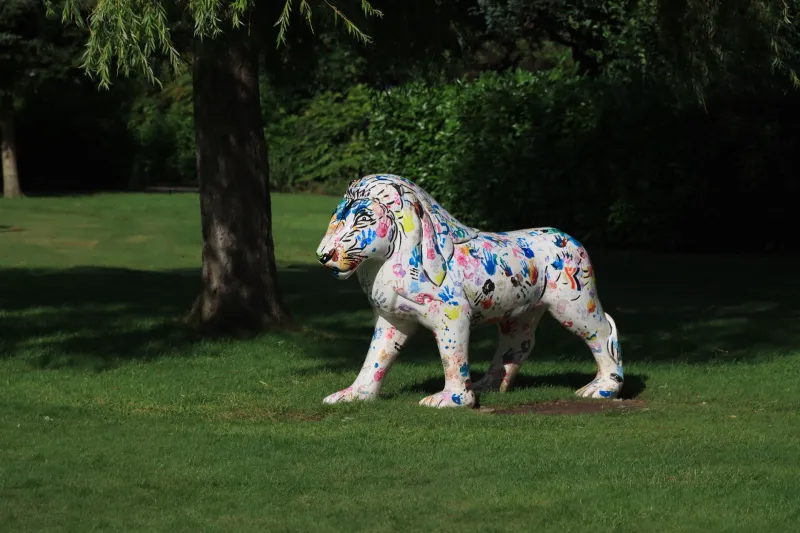
On a damp November morning at Rendcomb College, the usual routes between lessons have acquired new landmarks. A sequence of pupil-made works now occupies lawns, walled corners and tree lines across the estate, forming a self-guided art trail that opened to the college community this month. The project, developed over the summer and autumn terms, has moved pupil artwork out of the studio and into the weather, where it is encountered by dog walkers, grounds staff, visiting families and pupils changing classes.
The trail is not a single exhibition in the conventional sense. It is a distributed route of installations, each chosen for its site rather than simply placed there. Visitors can follow a printed map or walk the grounds without one; either way, the works are encountered in the open, subject to wind, rain and the ordinary life of a busy campus. That exposure is part of the point.
From Sketchbook to Site Survey
The project began in the art department as a series of sketchbook enquiries into scale, material and public space. Pupils were asked to consider not only what they wanted to make, but where a work might live and who might see it. Early ideas included textile pieces, carved forms, painted panels and structures assembled from reclaimed timber. Some were quickly revised when pupils walked the grounds with the estates team and considered practical questions: drainage, footfall, prevailing wind and the needs of grounds maintenance.
A pupil curatorial group took responsibility for shortlisting sites. The group included pupils from different year groups, and their discussions were recorded in a working document that became part handbook, part argument. Proposals were assessed against a simple but demanding set of criteria: could the work be made weatherproof without losing its character, could it be installed safely, and would it reward a passer-by who had not read the accompanying text?
The final route includes works near the main drive, along the edge of the lake and in quieter corners where pupils might not ordinarily linger. Each piece carries a small label with the pupil's name, year group and a short statement. The labels are deliberately brief. The intention, according to those involved, is to encourage looking first and reading second.
The Practicalities of Showing Outdoors
Outdoor display brings constraints that studio work does not. Materials had to withstand moisture and temperature changes; fixings had to be secure without damaging trees or turf; and installations had to be checked before opening and monitored during the run. The estates team worked alongside pupils and staff to assess ground conditions and agree installation methods, while the art department adapted finishes and supports where necessary.
One painted panel, originally conceived for an indoor wall, was reworked with a sealed surface and a freestanding frame after a site visit revealed that the intended wall received little shelter. A group of sculptural forms was repositioned after the grounds team pointed out that their original location interfered with a drainage channel. These adjustments were not treated as compromises, but as part of the design process.
The trail also required a modest maintenance rota. Pupils check works during the week, noting any damage or weather-related wear, and the estates team keeps an eye on the route during routine grounds work. The arrangements are deliberately low-key. As one member of staff put it, the aim is to let the works settle into the landscape rather than treat the grounds as a fragile museum.
Confidence Built in Public
For the pupils involved, the move outdoors has changed the nature of feedback. In a studio, work is usually seen by a teacher or a class. On the trail, it is seen by people who may have no context for it at all. Pupils have reported that this is both exposing and liberating. Several have found themselves explaining their work to visitors who stopped to ask questions, sometimes in the middle of a free period.
Those conversations have been varied. Some visitors have asked about materials and technique; others have offered interpretations that the artist had not considered. One pupil described a discussion with a member of the catering team about a textile piece inspired by kitchen gardens, which led to a wider conversation about food waste and household routines. Another recalled a younger pupil asking whether a work was 'a seat or a sculpture', a question that prompted a thoughtful reconsideration of the piece's purpose.
The curatorial group has kept a simple feedback book at the main reception, and comments have been collected from staff, pupils and visitors. The responses are not uniformly positive, and those involved say that is appropriate. Public display invites judgement, and learning to receive it with equanimity is part of the exercise.
A Stronger Sense of Place
The trail has also altered how some members of the college community move through the grounds. Routes that were previously functional have become deliberate. Staff have reported walking a longer way between buildings to see works they had heard about; pupils have used the trail as a meeting point; and visiting families have been given a reason to explore parts of the estate that are not on the standard tour.
The works respond to Rendcomb's particular landscape rather than to a generic outdoor exhibition model. One installation uses fallen timber from the estate; another takes its palette from the stone of nearby buildings; a third is positioned to frame a view of the lake that many visitors had not previously noticed. The result is a trail that could not easily be relocated elsewhere without losing meaning.
Teachers have begun to use the route as a teaching resource. Geography pupils have considered sightlines and visitor movement; biology pupils have discussed the impact of installations on marginal habitats; and English pupils have used the works as prompts for descriptive writing. The connections are not forced, but they are available.
What Comes Next
The trail remains open until early December, after which the works will be removed and, in several cases, returned to pupils or archived. The curatorial group is preparing a short evaluation for the art department and the wider college, covering installation, maintenance and visitor response. There is no firm decision yet on a repeat, though those involved have spoken positively about the project's potential to become an annual fixture.
For now, the trail stands as a modest but distinctive addition to the winter term. It asks visitors to look again at a landscape they may think they know, and it asks pupils to stand by work that is exposed to the elements and to the public. Both are useful disciplines. As one of the pupil curators observed, the weather has been unpredictable, the feedback has been mixed, and the experience has been all the more valuable for it.