Names, Not Numbers: Rendcomb's 2026 Remembrance Archive Comes Into Focus
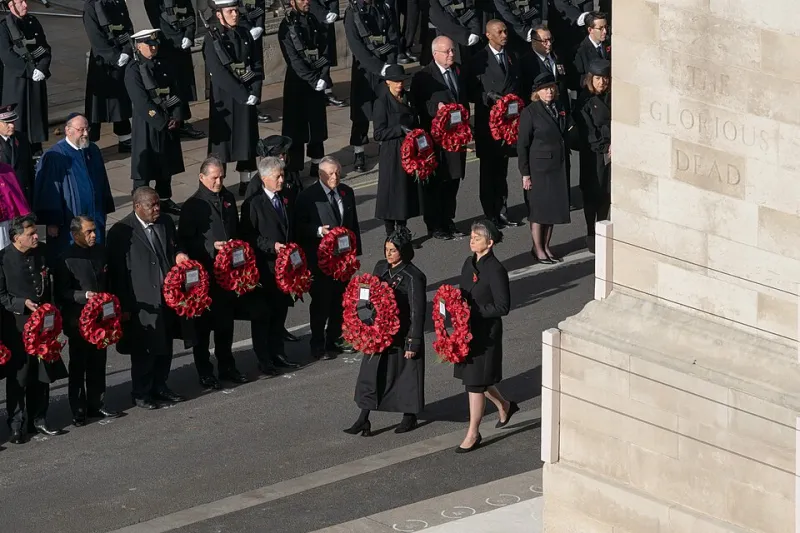
Photo: Department for Culture, Media & Sport, CC0, via Wikimedia Commons
At 10.45am today, the bell at Rendcomb College will signal the start of a Remembrance Sunday shaped, in large part, by pupils. The chapel service, the two-minute silence at 11am and the poppy installation on the chapel lawn are familiar elements of the college calendar. This year, however, they sit alongside a quieter piece of work: a student-led archive project exploring the lives of former pupils named on the college memorial.
The project began in the Michaelmas term, when a small group of Year 12 historians asked whether the names on the memorial could be more than a list. With support from the history department and the college archivist, pupils have been using census returns, local newspaper reports, school magazines and family correspondence to build short biographies of the former pupils remembered in the chapel. Their findings will inform today's service and form the basis of a digital exhibition planned for later in the academic year.
A Memorial Made Personal
The college memorial, dedicated after the First World War, records the names of former pupils who died in conflict. For generations it has provided a focal point for remembrance at Rendcomb, near Cirencester. The archive project aims to give those names context: where pupils lived, what they studied, which teams they played for and whom they left behind.
'We wanted to move beyond initials and dates,' said Year 12 pupil Lottie M., one of the project's student researchers. 'When you find a letter or a photograph, the person stops being a name on a plaque and becomes someone with a family, a sense of humour and a future that was cut short.'
One line of enquiry has already caught the group's attention. A former pupil from the Cirencester area is recorded as having walked to Rendcomb each week because the family could not afford the train fare. Another is remembered in a school magazine for his skill at cricket and his reluctance to write essays. Such details are small, but they are the kind of detail that makes remembrance feel local and human.
A Service of Words and Silence
Today's chapel service will draw directly on the pupils' research. Readings will be interspersed with short biographical notes read by members of the school community, and the roll of honour will be read aloud by pupils from Year 9 to Year 13. The choir will lead the singing, and a bugler will sound the 'Last Post' before the two-minute silence at 11am.
The Head of History said the archive has changed the way pupils approach the memorial. 'The names have always been there, but the research has given them a narrative,' she said. 'Pupils are not simply remembering in the abstract. They are learning that remembrance involves attention, accuracy and a willingness to ask difficult questions about the past.'
The service will also include an act of commitment, led by the college's senior pupils, and a wreath-laying at the memorial. Families attending are asked to be seated in the chapel by 10.30am. For those unable to join in person, the college will share a short reflection and photographs from the installation later in the day.
Poppies, Place and Public Memory
Outside the chapel, the poppy installation offers a visual counterpart to the archive work. Pupils in the lower school have made poppies from recycled felt and wire, each one attached to a simple wooden frame on the chapel lawn. The installation is deliberately understated: no bright lighting, no amplified sound, just a field of red against the autumn grass.
The art department and grounds team worked together on the project, which will remain in place until Armistice Day on 11 November. Pupils involved in making the poppies said the process encouraged them to think about the meaning of the symbol rather than simply wearing it. 'It is easy to put on a poppy and forget what it stands for,' said one Year 8 pupil. 'Making one made me slow down.'
The installation is open to visitors after the service, and the college has invited neighbours and members of the local community to view it during daylight hours. Refreshments will be served in the dining hall, where pupils will display some of the archive material gathered so far.
Research as Remembrance
The archive project is not intended to glorify conflict. Its aims are more modest and more demanding: to understand the lives behind the names, to recognise the cost of war and to practise the skills of historical enquiry. Pupils have been encouraged to acknowledge uncertainty, to distinguish between evidence and inference, and to avoid turning biographies into simple morality tales.
'Remembrance is often treated as a moment rather than a discipline,' the Head of History added. 'This project asks pupils to keep returning to the evidence, to revise their conclusions and to treat the past with care. That is a form of respect.'
The college hopes the digital exhibition will be available to alumni and local historians later in 2026. Pupils are also exploring links with Cirencester's library and archive services, where several of the sources used in the project are held.
A Community Invitation
Today's commemorations are open to pupils, staff, families and invited guests. The college asks visitors to arrive by 10.30am for the chapel service, which begins at 10.45am. The poppy installation will be open after the service, and the archive display will be available in the dining hall until early afternoon.
In a year when public remembrance has often been conducted at a distance, Rendcomb's approach is quietly ambitious. It places pupils at the centre of the work, not as spectators but as researchers, readers and hosts. The result is a Remembrance Sunday that honours the past while asking what it requires of the present.